Yes, you can sell a car with a loan in Tampa — the loan does not stop the sale, but the lien has to be satisfied before the title can move to the buyer. In practice, get the payoff figure from your lender, and make sure the money reaches the lender at closing. Whether you sell a car with a loan privately or to a dealer, the rule is the same — the buyer pays, the lender gets paid, and the lien is released.
Can You Sell a Car With a Loan in Tampa? The Short Answer
The short answer is yes — you can sell a car with a loan. The lien holder has to be paid off at closing. How the money moves depends on who buys the car when you sell a car with a loan. Get the payoff figure first when you sell a car with a loan.

Yes — If the Lien Is Satisfied at Closing
A lien means the lender has a legal claim on the car until the loan is paid in full. When you sell a car with a loan, the payoff goes to the lender first, and only the surplus goes to you. The buyer cannot get a clean title until the lender releases the lien, which is why no buyer should hand over full payment without a payoff plan in place.
Private Sale vs Dealer or Buyer Sale at a Glance
Private sales and dealer sales move the payoff money differently. A private buyer usually pays you, and you pay the lender — or the buyer pays the lender directly if agreed in writing. A dealer or cash buyer usually pays the lender directly and handles the lien release as part of the sale.
| Route | Who pays the lender | When the title moves |
|---|---|---|
| Private sale | You pay the lender, or the buyer pays it directly if agreed in writing | After the lien release arrives |
| Dealer or cash buyer | The buyer pays the lender directly and files the lien release | After the buyer files the payoff |
Positive vs Negative Equity in One Formula
Equity is one subtraction: the car’s sale price minus the loan payoff. If the price is higher, you have positive equity, and the difference is yours. If the payoff is higher, you have negative equity, and the gap has to come from somewhere. Every decision in this guide starts from that one number, so get your payoff figure before you agree a price when you sell a car with a loan.
How Loan Payoff Works in Florida
Before you can sell a car with a loan, you need one number from your lender: the payoff. It is not the balance on your last statement — it changes daily, because interest accrues on the balance you still owe. The sections below explain the quote, the lien, and how the release travels.

Get Your 10-Day Payoff Quote, and Why It Differs From Your Balance
Ask your lender for a payoff quote — usually called a 10-day payoff — for the exact amount needed to close the loan by a stated good-through date. The figure is higher than your statement balance because interest accrues daily — the quote adds the interest that will build up before the payoff date, plus any fees. Most quotes stay valid for 10 to 15 days; if the money arrives late, the lender charges more per diem, so ask for the good-through date and the daily rate when you sell a car with a loan.
The Lender Lien and Florida’s ELT Title
Florida uses an electronic lien and title system, known as ELT, so most financed cars have no paper title. The lender’s lien sits on the electronic title record. When the payoff clears, the lender releases the lien electronically. That release is what lets the buyer apply for a new title when you sell a car with a loan.
Payoff at Sale and How the Lien Release Is Transmitted
At closing, the payoff goes to the lender by check or wire, and the lender sends the lien release to the state electronically — days, not weeks. Ask for written proof: a payoff confirmation, the release, or a confirmation number. Check the title record on the FLHSMV Vehicle Information Check tool before you call the sale done after you sell a car with a loan.
Selling With Positive Equity: When the Car Is Worth More Than the Loan
Positive equity is the easy case: the car is worth more than the payoff. Agree the numbers in writing before the car leaves, so the surplus is never a surprise when you sell a car with a loan.
Work Out Your Surplus: Price Minus Payoff
The surplus is the sale price minus the payoff on the good-through date, not last month’s balance. Illustrative only, round figures: an $18,000 sale price and a $14,000 payoff leave a $4,000 surplus. Work it out with the payoff quote in hand. Run the numbers before you sell a car with a loan, not after.
How the Surplus Is Paid: Check vs Trade-In Credit
A private or cash buyer usually pays the surplus by check once the lender confirms the payoff. At a dealer, the surplus can go toward your next car instead — that is the trade-in credit, and in Florida it also cuts the sales tax on the new car. Get the surplus figure on the receipt before the car leaves when you sell a car with a loan.
Confirm $0 Balance Before You Call It Done
Do not call the sale done when the car leaves — call it done when the lender confirms a $0 balance. Ask for a payoff confirmation letter, and check the title record a few days later to confirm no lien remains. If the confirmation is late, keep the bill of sale and the payoff receipt together until it arrives after you sell a car with a loan. Keep the proof after you sell a car with a loan.
Selling With Negative Equity: When You Owe More Than the Car Is Worth
Negative equity means you owe more than the car is worth: the gap has to be paid from somewhere before the title can move when you sell a car with a loan. Edmunds’ Q3 2026 analysis found nearly 3 in 10 trade-ins with a loan were underwater. The video walks through what rolling that gap into a new loan really costs.
Pay the Shortfall in Cash at Closing
The simplest way out is to pay the gap in cash at closing. Illustrative only, round figures: a $20,000 payoff and a $17,000 sale price leave a $3,000 shortfall, and that $3,000 has to reach the lender before the lien is released. The Consumer Financial Protection Bureau notes the same rule: you still owe the lender the full payoff. Bring the money to closing, or the sale cannot finish. Get the payoff and the price agreed in writing first, so the gap is a known number when you sell a car with a loan.
Roll It Into a New Loan — Trade-In Only, and What It Really Costs
Rolling the shortfall into a new loan works only as a trade-in at a dealer — a private or cash buyer cannot roll your old loan into anything. The dealer adds the gap to the new car’s loan, so you pay interest on the old debt for years. The video above shows buyers who rolled the gap financed far more and paid far more interest. Our guide to a dealership trade-in vs cash offer covers the tax credit and the timing. Compare the total cost of the new loan, not the monthly payment, before you sell a car with a loan this way.
Wait, Pay Down Principal, or Reconsider Selling Now
If the gap is small, waiting is often the cheapest option. Pay a little extra each month toward principal. If the sale is not urgent, waiting until the payoff and the value cross can save more than any quick sale when you sell a car with a loan.
How a Dealer or Cash Buyer Handles Your Loan
Who pays the lender, and when, decides whether the sale goes smoothly. A dealer or cash buyer usually handles it directly, while a private sale needs the two sides to agree the money route in writing. Get that agreement before pickup day when you sell a car with a loan.
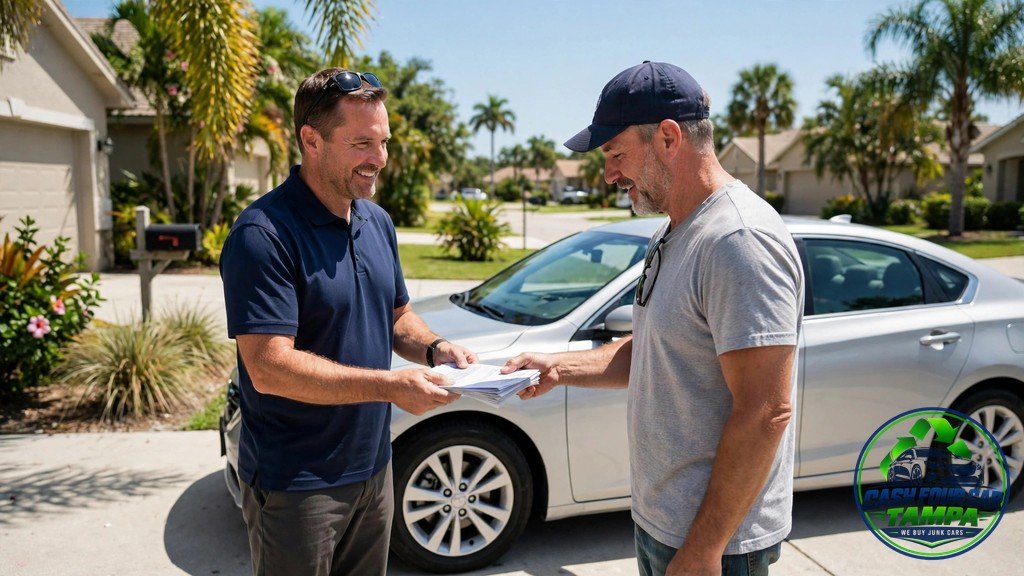
Dealer or Buyer Pays Your Lender Directly: The Normal Flow
The normal dealer flow is simple: the buyer agrees a price, gets the exact payoff from your lender, and pays the lender directly. The lender releases the lien, and any surplus comes to you as a check or credit toward another car. Ask for the payoff confirmation before the car leaves, and keep it with the bill of sale when you sell a car with a loan to a dealer.
Private-Buyer Payoff Coordination
A private buyer can pay the lender directly too, but only if you agree it in writing before money moves. Pay by cashier’s check or wire so the payment is traceable. Never accept a promise to pay the lender later, and never hand over the title before the payoff is confirmed when you sell a car with a loan.
What to Get in Writing Before You Hand Over the Car
Before the keys change hands, get four things in writing: the sale price, the payoff amount and good-through date, who pays the lender, and what happens to any surplus. A bill of sale with those four lines protects both sides. If the buyer will not put the payoff route in writing, stop the sale — a handshake is not a payoff plan when you sell a car with a loan.
Paperwork for a Financed-Car Sale — Pointers Only
The paperwork is the same as any car sale, with the lien release added on top. This section is pointers only — each item links to the guide that covers it in full, so you can sell a car with a loan without re-reading the process here.
Title, Photo ID, VIN, and Odometer: Link Out
Bring the title or ELT record, a photo ID, the VIN, and the odometer. The full checklist is in our guide to the documents needed to sell a car, and the signing steps are in our guide to transfer a car title. Check both before closing day, so a missing paper does not delay the payoff when you sell a car with a loan.
Lien Release, Plates, and Notice of Sale Within 30 Days: Link Out
After the payoff, get the lien release in writing, take your plate off, and file the Notice of Sale on Form HSMV 82050 within 30 days, as Florida Statute §319.22 requires. The full after-sale order is in our guide to what to do after selling your car — follow it in order after you sell a car with a loan.
If the Title Is Missing or the Car Is Derelict: Pointers Only
A missing title means a duplicate title on Form HSMV 82101 first, and a qualifying derelict may go the Form HSMV 82137 route instead — ask which route applies first. Do not sign a title you do not have, and do not agree a payoff date until the title route is settled, or the sale can stall after you sell a car with a loan.
Red Flags When Selling a Car With a Loan
Most financed sales go through cleanly, but the bad ones show the same red flags. Learn them before you agree a price when you sell a car with a loan.
I’ll Take Over Your Payments and Title Jumping
“I’ll take over your payments” sounds helpful, but it leaves the loan and the title in your name. The buyer never titles the car — that is title jumping — and every toll, ticket, and missed payment still comes back to you. The loan stays yours until the payoff clears, so never agree to a payment takeover when you sell a car with a loan.
No Payoff Confirmation, or Payoff Promised After Towing or Pickup
A buyer who will not show the payoff confirmation before the car leaves is asking you to trust them. Worse is a payoff promised after towing or pickup. The payoff must be confirmed before loading, in writing, with a confirmation number or receipt. No confirmation, no handover, when you sell a car with a loan.
Broker Pass-Throughs, Blank Titles, and Pickup-Day Price Cuts
Watch for a broker who passes your car to another buyer without telling you, a blank title, and a price cut on pickup day after the payoff was agreed. Each one shifts the risk onto you. Get the buyer name, the price, and the payoff route in writing before pickup day when you sell a car with a loan.
Selling a Financed Car in Tampa and Hillsborough County
Tampa dealers who buy financed cars say so on their own pages. The summary below is what each dealer publishes — not an endorsement. Check the dealer’s own site before you go, and confirm the payoff route on the call when you sell a car with a loan.

What Tampa Dealers Actually Say They Do: Gettel, Rivard, Veterans Ford — Summarised, Not Endorsed
Gettel Stadium Toyota says it buys cars outright with no purchase required, contacts your lender for the exact payoff, pays the lender directly, and handles the lien release; if the car is worth more than the payoff, the difference comes as a check or toward another vehicle. Veterans Ford Tampa says it buys cars with remaining loan balances and helps pay off the existing loan, and asks for a license, title or payoff information, registration, and keys. Rivard Buick GMC says it buys cars through its We Buy Cars program with no purchase required; its pages do not describe its loan-payoff process, so confirm on the call how it handles the payoff before you sell a car with a loan there.
Where Tampa Sales Are Filed: Hillsborough County Tax Collector as FLHSMV Agent
Title work in Tampa runs through the Hillsborough County Tax Collector, the FLHSMV agent. The downtown office is at 601 E Kennedy Blvd, with branches on Falkenburg Road, Hillsborough Avenue, and Westshore Boulevard. Bring the signed title, photo ID, proof of Florida insurance, and payment — and confirm the branch handles title work before you go when you sell a car with a loan.
Tampa Timing Reality: Liened Sales Take Longer Than Cash-on-Spot Sales
A cash-on-the-spot sale can finish the same day, but a liened sale usually cannot: the lender has to confirm the payoff and release the lien. Same-day pickup may still happen, but the title work follows. Ask the buyer for a realistic timeline before pickup day, and do not promise a buyer a same-day title when you sell a car with a loan. Plan for days, not hours, when you sell a car with a loan.
Sell My Car in Tampa With a Loan? Get a Cash Four Car Tampa Offer
Cash Four Car Tampa buys cars across Tampa and Hillsborough County. Tell us about the loan first, and we will confirm before pickup what we can handle when you sell a car with a loan. Tell us the payoff first when you sell a car with a loan.
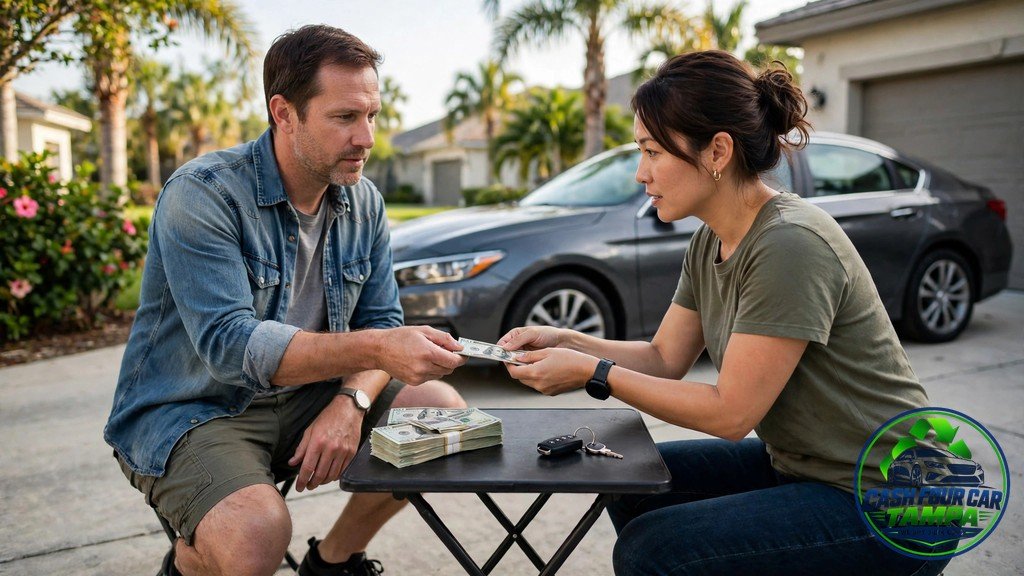
What to Tell Us First: Lender and Payoff
Have the lender name, payoff amount, good-through date, VIN, and title status ready when you call. A 10-day payoff quote is the most useful single document — it tells us the exact figure the lender needs and the date it is good through. With those numbers in hand, the offer conversation is about the car, not the paperwork, when you sell a car with a loan.
What Happens Next: Confirm Before Pickup What We Can Handle
Title paperwork help and no-title cases are not promised on the homepage, so ask on the call whether we can handle your loan payoff and lien release. The quote takes less than 60 seconds. To start, get a quote online or call (813) 321-4445 any day from 7:00 AM to 9:00 PM. With 4.9 out of 5 stars from more than 127 reviews and over 500 cars purchased, the record is public.
FAQs: Selling a Car With a Loan in Tampa
The same three questions come up on almost every financed sale in Tampa. The payoff quote answers most of them before you sell a car with a loan. The short answers are below. Start with the payoff quote.
Must I Pay Off My Loan First in Tampa?
No — you do not have to pay off the loan before the sale, as long as the payoff happens at closing. The buyer pays the lender directly, or you pay the lender from the sale money. What you cannot do is hand over a clean title while the loan is still open when you sell a car with a loan.
What Is a 10-Day Payoff Quote in Tampa?
A 10-day payoff quote is your lender’s written figure for the exact amount needed to close the loan by a stated good-through date. It is higher than your statement balance because it adds the daily interest until the payoff date. Ask your lender for the quote, the per-diem rate, and the good-through date before you sell a car with a loan.
What If I Owe More Than My Car Is Worth in Tampa?
Pay the gap in cash at closing, wait and pay down principal, or trade the car in at a dealer and roll the gap into the new loan. A private buyer or cash buyer cannot roll your loan into anything. Compare the total cost of any new loan, not the monthly payment, before you sell a car with a loan.