
In Tampa, two ways turn an old car into money: trade it in at a dealership against another car, or take a direct cash offer. The dealership trade-in vs cash offer question has no single right answer. A dealership trade-in vs cash offer choice depends on whether you are buying another car, how fast you need the money, and what your car is worth.
The Short Answer: When Trade-In Wins, When a Cash Offer Wins
A trade-in wins when you are buying another car in the same deal at the same dealership. In a dealership trade-in vs cash offer, a cash offer wins when you are not buying anything, need the car gone this week, or it will not retail cleanly.

Trade-In Wins When You Are Buying Another Car in the Same Deal
A trade-in wins when the old and new cars change hands in one transaction with a registered dealer. The dealer’s offer goes straight to the replacement, and Florida gives a sales-tax credit on the trade-in allowance under §212.09. A dealership trade-in vs cash offer comparison has to count that credit, because a separate cash sale gets no credit, even if you spend the cash on another car the next day.
A Cash Offer Wins When You Are Not Buying, Need Speed, or the Car Won’t Retail Cleanly
A cash offer wins when there is no replacement car in the picture: with no purchase, the trade-in tax credit is worth nothing. That is the dealership trade-in vs cash offer answer when no replacement is involved. A cash offer also wins on speed — one quote, one pickup, payment before loading, usually the same day or the next. And it wins when the car will not retail cleanly — damaged, high-mileage, non-running, or salvage title — because a dealer who must retail it prices it low.
Use Net Value, Not the Headline Offer: The 4-Line Comparison
Compare the two routes on four lines: the offer, the tax credit only a trade-in gets, the dealer fees only a trade-in pays, and your time and effort.
How a Dealership Trade-In Works in Tampa
A trade-in is two sales in one visit: the dealer buys your old car and sells you another, both prices negotiated in the same room. The dealership trade-in vs cash offer difference starts here: a trade-in bundles the sale and the purchase, holding both the tax credit and the dealer fees.
Appraisal: What the Dealer Actually Prices
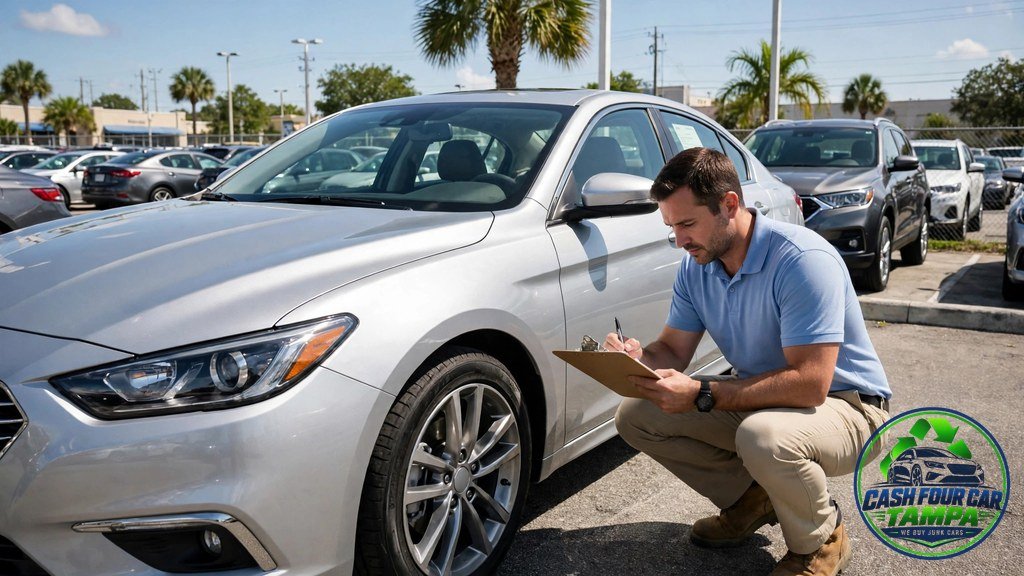
The dealer appraises your car as a wholesale purchase, not a retail sale. The appraiser checks year, make, model, mileage, condition, title status, and auction prices for similar cars, then subtracts reconditioning costs and the margin to resell it. In a dealership trade-in vs cash offer comparison, the appraisal is the dealer’s wholesale number, rarely the number you hoped for.
The video below, from The CFO Next Door, shows the four places a dealership makes its money — starting with the trade-in — purely educational, no service pitch. A dealership trade-in vs cash offer viewer should start with the trade-in section, which shows how the appraisal number is built.
The Offer, Applied to the Replacement: Negotiate the Two Prices Separately
The trade-in offer is applied to the replacement car’s price, so the two numbers move together. A dealer can raise both prices by the same amount, and the deal looks better while costing you the same. Negotiate them separately: settle the replacement price first, then the trade-in allowance, and get both in writing before you sign. A dealership trade-in vs cash offer check needs the replacement price fixed — a generous trade-in on an overpriced replacement is not generous.
Payoff, Tax Credit, and Dealer Fees on the Replacement
If you still owe money on the old car, the dealer pays the loan off from the trade-in allowance; any shortfall comes from your pocket or goes into the new loan. The tax credit then applies to the replacement: Florida taxes only the price minus the trade-in allowance. That is the dealership trade-in vs cash offer tax math in one line. But the replacement also carries dealer fees — a dealer fee, a documentation fee, sometimes add-ons — that eat into the credit. In a dealership trade-in vs cash offer comparison, add the fees to the replacement side, because a cash sale has no replacement and no fees.
How a Direct Cash Offer Works
A direct cash offer is one transaction: a buyer quotes a net cash number, picks the car up, and pays before it is loaded. The dealership trade-in vs cash offer difference here is simplicity: one number, one pickup, one payment.
Get a Written, Net Quote and Compare It Before You Commit
Ask for a written, net quote — one cash number, towing included, nothing deducted at pickup — by text or email, so you can compare it with another buyer. A fair cash offer should be easy to compare, and in a dealership trade-in vs cash offer, a buyer who will not put the number in writing is one to avoid. In a dealership trade-in vs cash offer comparison, judge the cash route by the written quote — compare it with the trade-in’s net value, not the headline allowance.
Inspection at Pickup or Appointment: When the Number Can Change
The quote is based on the facts you gave on the call — year, make, model, mileage, condition, title status — and the buyer checks them at pickup or appointment. If the description was wrong — the car does not run, the title is missing, parts are gone — the number can change, and the buyer should explain why before loading. The dealership trade-in vs cash offer inspection rule is simple: the number follows the facts. A dealership trade-in vs cash offer risk: a dealer can also reprice at the desk, so a quote that moves without a reason is a reason to walk away.
Paperwork at Pickup and Payment: Pointers Only, Do Not Detail Here
Paperwork at pickup is short: the title in the seller’s name, a photo ID, the VIN, and the odometer reading, plates removed before the car leaves. File the Notice of Sale on Form HSMV 82050 within 30 days, as Florida Statute §319.22 requires. If the title is missing, ask which route applies — duplicate title or derelict filing — rather than assuming the sale cannot happen. A dealership trade-in vs cash offer sale uses the same paperwork.
Price Comparison: Trade-In vs. Cash Offer vs. Private Sale — Net, Not Gross
Three routes, three different numbers: in a dealership trade-in vs cash offer, a trade-in allowance is not cash in your hand, a cash offer is, and a private-sale price is a gross figure before costs. The dealership trade-in vs cash offer comparison below uses net value — what you keep after tax, fees, costs, and time.
What Each Number Really Is
The trade-in allowance is a credit against a replacement car, not money you receive. In a dealership trade-in vs cash offer comparison, the cash offer is the only number needing no adjustment — the other two need their costs subtracted first. That is the dealership trade-in vs cash offer net-value rule.
A Net Worked Example: Illustrative Only
Illustrative only — round figures, not real Tampa prices. Take a $20,000 replacement car and an $8,000 trade-in allowance. The trade-in taxes only $12,000: 6% state tax is $720, plus 1.5% surtax on the first $5,000 ($75) — $795 total. Without it, the same car costs $1,200 in state tax plus $75 surtax — $1,275. The trade-in saves $480 in tax, so its net value is $8,480 before dealer fees. A $9,500 cash offer beats that net value by $1,020 — unless dealer fees are small and the replacement price is good. A private sale at $11,000 gross nets about $10,600 after roughly $400 in costs, but takes weeks. In a dealership trade-in vs cash offer worked example, the trade-in only wins when the tax saving and convenience beat the cash offer’s higher number.
Why the Ranges in Secondary Sources Disagree — and Why Tampa Has No Published Gap
Published national trade-in gap figures disagree because they measure different things: some compare allowances with private-party retail prices, some with dealer retail prices, and some use auction data. And no published Tampa-specific gap exists at all — no Tampa study, no Hillsborough dataset, no local index tracking what trade-ins pay against cash offers here. In a dealership trade-in vs cash offer decision, run your own four lines on your own car instead of trusting a national average.
| Factor | Dealership trade-in | Direct cash offer | Private sale |
|---|---|---|---|
| What you receive | Credit against the replacement car | Net cash at pickup | Gross price, before costs |
| Tax effect | Tax credit on the allowance | No credit, no tax on the sale | No credit, no tax on the sale |
| Extra costs | Dealer and documentation fees | None | Listing, detailing, repairs, time |
| Paperwork | Dealer files transfer and payoff | Buyer files transfer at pickup | You file transfer and Notice of Sale |
The Florida Trade-In Tax Credit: How It Really Works
The trade-in tax credit is a trade-in’s one real advantage over a cash offer, and its most misunderstood part. It cuts the taxable price of the replacement car, and exists only when the old and new cars change hands in one transaction with a registered dealer. A dealership trade-in vs cash offer comparison must count it.
The Statute: FL §212.09, Same-Transaction Dealer Trade Only
Florida Statute §212.09 says where a used article is taken in trade as a credit or part payment on the sale of another article, the tax is paid on the price less the credit. Sell privately, take the cash to the dealer the next day, and Florida sees two separate deals, each taxed on its full price. The dealership trade-in vs cash offer tax answer: same transaction with a registered dealer, credit applies; separate sale, it does not.
The Maths: 6% State Tax on Price Minus Allowance; Hillsborough Surtax 1.5% on the First $5,000 Only
Florida charges 6% state sales tax, plus a 1.5% Hillsborough discretionary surtax (7.5% combined) — but the surtax applies only to the first $5,000 of a single item, the state tax to the full price. The Florida Department of Revenue’s sales tax guidance confirms the 6% rate, the county surtax, and the $5,000 cap per item. The example above shows the same split: $720 state tax, $75 surtax. The credit saves 6% of the allowance — $480 here — and nothing on surtax, capped at $5,000 in both cases. A dealership trade-in vs cash offer tax calculation that applies 7.5% to the whole saving is wrong.
When the Credit Collapses
The credit collapses in four common cases. That is when the dealership trade-in vs cash offer credit disappears. First, you are not buying another car — no purchase for the credit to reduce. Second, you sell first and buy later, even the same week — the law needs one transaction. Third, the trade is with a private party, not a registered dealer. Fourth, the dealer inflates the replacement price by the credit amount. A dealership trade-in vs cash offer decision should check all four before counting the credit.
Negative Equity and Loans: Underwater, Payoff, and Rolling the Balance
Negative equity is the quiet trap in any trade-in or sale: you owe more than the car is worth, and the gap must be paid by someone. The dealership trade-in vs cash offer question gets harder with an underwater loan: the offer is no longer the only number — the payoff is a number too.
Underwater in One Line: Payoff Minus Offer = Negative Equity
Negative equity is one subtraction: the loan payoff minus the offer is the amount you are underwater. That is the dealership trade-in vs cash offer negative-equity math. If the payoff is $12,000 and the allowance or cash offer is $9,000, the negative equity is $3,000, which must come from somewhere before the car changes hands. A dealership trade-in vs cash offer comparison with an underwater loan is not about which offer is higher — it is about the smaller gap, and whether you can cover it.
Rolling It Into the New Loan Is Lender Approval, Not a Dealer Promise
A dealer may offer to roll the negative equity into the new loan, but that is the lender’s decision, not the dealer’s promise. The lender checks loan-to-value, your credit, and the replacement car’s value, and can say no — or approve only with a larger down payment. Rolling it also means paying interest for years on a car you no longer own. A dealership trade-in vs cash offer choice that rolls the balance needs the lender’s written approval, not the dealer’s spoken word.
The Safer Alternatives to Rolling
First, pay the difference in cash, so the loan closes clean and the new one starts at zero. Second, sell privately for a higher gross price — a private buyer pays closer to retail, though it takes weeks. Third, wait and pay the loan down until the payoff meets the car’s value, then sell. A dealership trade-in vs cash offer decision with negative equity should price all three before accepting a roll.
Tampa and Hillsborough Specifics: Dealers, Neighbourhoods, Filing Office, and What Competitors Miss
A dealership trade-in vs cash offer choice in Tampa is not the same as one in another state, because Florida’s tax credit and title rules are its own.
What Tampa’s Named Dealers Actually State: Verify, Policies Change
No dealer policy is quoted here, because policies change often and this guide does not invent them. The dealership trade-in vs cash offer rule is the same: read the current terms. Tampa’s franchised dealers and large used-car retailers each publish trade-in pages, appraisal tools, and purchase terms that move with the market. Before you trade in, read the dealer’s published terms, check whether the appraisal is an offer or an estimate, and get the final numbers in writing. A dealership trade-in vs cash offer decision should rest on the dealer’s current written terms, not a policy quoted from an article that may be years old.
Tampa and Hillsborough Geography and the Filing Office
Trade-ins and cash sales happen across the whole county — downtown Tampa, Brandon, Riverview, Wesley Chapel, and Valrico. The ZIP codes below are geography only, not a coverage promise: 33602, 33607, 33609, 33629, 33610, 33612, 33617, 33618, and 33647. Title transfers go through the Hillsborough County Tax Collector, the county’s FLHSMV agent — downtown at 601 E Kennedy Blvd and on Falkenburg Road, Hillsborough Avenue, and Westshore Boulevard. A dealership trade-in vs cash offer filing runs through the same office either way; pickup in any neighborhood is confirmed on the call.
What Tampa Competitors Cover — and What They Miss
Typical dealership trade-in vs cash offer articles cover the headline offers and the convenience of a trade-in, and most miss the same four things: the tax-credit math, the $5,000 surtax cap, dealer fees, and the negative-equity question. A private sale vs car buyer comparison has the same gap problem, which is why this guide compares net value. A dealership trade-in vs cash offer article that never shows the arithmetic is a sales pitch, not a comparison.
Sell Your Car in Tampa Without the Trade-In Runaround — Cash Four Car Tampa
If you are not buying another car, the trade-in route offers you nothing but a lower number and a longer day. Cash Four Car Tampa buys your car outright: one call, one written quote, and a same-day pickup. With 4.9 out of 5 stars from more than 127 reviews and over 500 cars purchased, the record is public. A dealership trade-in vs cash offer decision ends here for sellers who want the car gone.
Get a Written Cash Offer and Compare It With Your Trade-In Net
Before you accept any trade-in, get a written cash offer and compare it with the trade-in’s net value: allowance, plus tax credit, minus dealer fees. If the cash offer is higher than the trade-in net, take the cash and skip the replacement. If speed matters too, the buyer route is built to sell your car fast in Tampa. The homepage promises a real cash offer in 60 seconds, the quote form under 60 seconds with no obligation. To start, get a quote online or call (813) 321-4445 any day from 7:00 AM to 9:00 PM. A dealership trade-in vs cash offer comparison is only honest with both numbers in writing.
Why a Local Cash Buyer Fits the Not Buying Another Car Case
A local cash buyer fits the case where there is no replacement car: the buyer pays cash and takes the car as it sits — wrecked, flooded, non-running, missing parts, or salvage title, as the homepage states. Free towing and same-day pickup are promised on the homepage, open 7 days a week from 7 AM to 9 PM — “Call before noon, we’re often there the same day”. If you want to sell your car without listing it, the cash route is built for that. A dealership trade-in vs cash offer choice for a seller who is not buying is usually no choice at all.
What to Have Ready: Pointer, Not a Procedure
Have the title in the seller’s name, a photo ID, all keys and remotes, and the payoff figure and lender’s name if a loan remains. Take daylight photos of the exterior, interior, dash, and every damaged area, so the quote is based on the real car. If the title is missing, say so on the call and ask which route applies. That is the dealership trade-in vs cash offer paperwork list. A dealership trade-in vs cash offer pickup moves fast either way.
FAQs: Dealership Trade-In vs. Cash Offer in Tampa
Three dealership trade-in vs cash offer questions come up on almost every call, and they all come back to the same thing: compare net value, not headline numbers.
Is Trade-In or Cash Offer Better in Tampa?
It depends on whether you are buying another car. A trade-in is usually better when you are buying a replacement in the same deal, because the tax credit adds real value — a dealership trade-in vs cash offer comparison must count it. A cash offer is usually better when you are not buying, need speed, or the car will not retail cleanly.
Do I Get a Tax Credit If I Buy Later, Not in the Same Deal?
No. Florida Statute §212.09 gives the credit only when the old car is taken in trade as part payment on another article in the same transaction with a registered dealer. Sell for cash, then buy a replacement days or weeks later, and Florida sees two separate deals, each taxed on its full price. A dealership trade-in vs cash offer decision that assumes a later purchase keeps the credit is wrong — the credit dies when the deals are separated.
Can I Trade In a Car I Still Owe Money On in Tampa?
Yes, if the numbers work. The dealer pays off the loan from the trade-in allowance; if the allowance is smaller than the payoff, you cover the difference in cash or roll it into the new loan with the lender’s approval. That is the dealership trade-in vs cash offer answer with a loan. In a dealership trade-in vs cash offer comparison with a loan, check the payoff figure first — it decides whether either route works without extra cash.