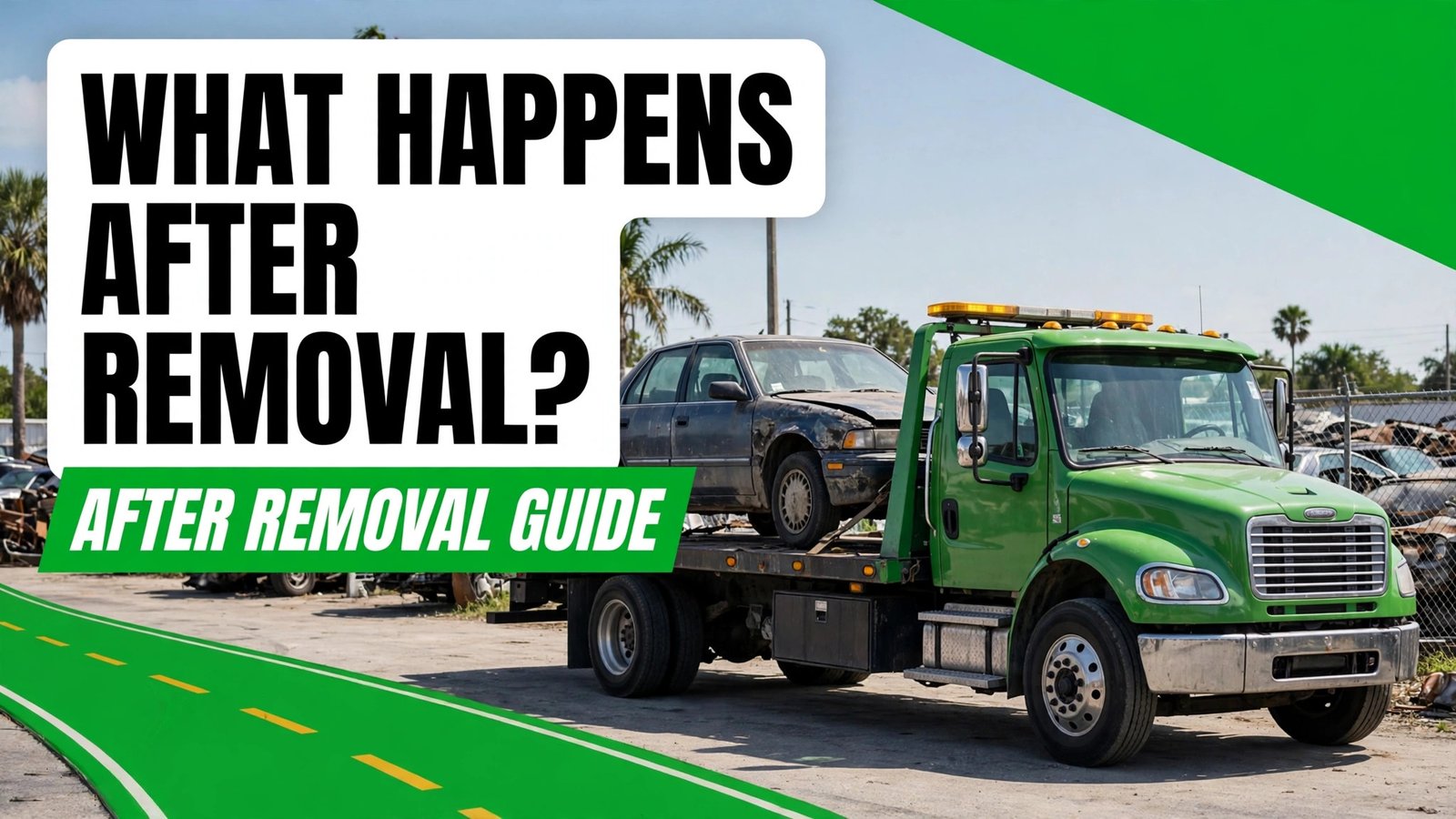
A car after removal in Tampa goes to a licensed salvage yard, where it is checked in, held if the law requires it, drained of fluids, stripped of parts worth saving, then crushed and shredded so its metal can be melted down and used again. Florida law sets out what must happen to the title, the fluids, the battery, and the catalytic converter.
The After-Removal Journey, Step by Step
The trip from your driveway to the shredder has four stages, and a car after removal in Tampa passes through each one in order. The trip starts with the same junk car removal service that picked the car up: tow and check-in come first, then any hold period the law requires, then depollution and parts harvesting, and finally crushing, shredding, and sorting.
Tow, Check-In and Inventory: VIN, Title, Condition
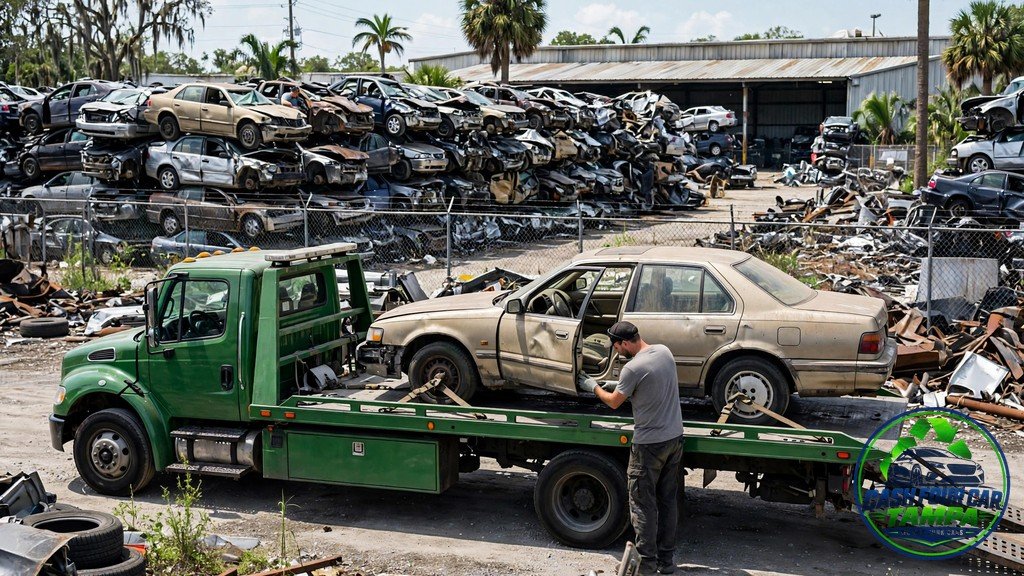
The yard records the VIN, matches it against the title you signed over, and notes the condition. A car after removal in Tampa is weighed and logged at this point, and the yard reports the purchase to the National Motor Vehicle Title Information System, the national database that stops a junked car from being re-titled later. That report is the moment a car after removal in Tampa officially leaves the road system.
| Step | What happens | What you do |
|---|---|---|
| Tow and check-in | VIN and title recorded; purchase reported to the national title database | Sign the title over, take the plate off, get a receipt |
| Hold period | Derelict cars held 3 business days, or 10 days with a recent lien | Nothing — the hold runs at the yard |
| Depollution and parts | Fluids drained, battery and airbags removed, good parts pulled for resale | File the Notice of Sale within 30 days |
| Crushing and shredding | Shell crushed, shredded, sorted into metals | Surrender or transfer the plate, then cancel insurance |
The Florida Hold Period for Derelict Cars
A derelict sale must wait out a hold before the dealer destroys it. The hold is 3 full business days when there is no active lien, or a lien at least 3 years old. With an active lien less than 3 years old, the hold is 10 days, and the department tells the lienholder. If the lienholder protests in writing within those 10 days, the department puts a 30-day hold on the record so the lienholder can claim the car. A car after removal in Tampa that arrives with a normal title and no derelict certificate does not wait through this hold — the hold is for derelict sales, not every pickup.
Depollution, Parts Harvesting, Crushing, Shredding, Sorting and Melting
Once any hold clears, the car is depolluted: fluids drained and recovered, battery out, airbags removed or deployed safely. What is left, mostly the body shell, is crushed flat and shredded into fist-sized pieces in seconds. Magnets pull out the steel, eddy-current separators throw out the aluminum, and the rest is sorted by density. A car after removal in Tampa ends this stage as sorted metal headed for a mill, not as a car at all.
The video below shows a recycling factory at work — a general look at shredding and sorting, not a Tampa yard.
What to Do After Removal: Your Tampa Seller Checklist
A car after removal in Tampa still has your name on the plate, the insurance policy, and the title record until you close each one out.
Remove and Surrender or Transfer Your Plate — Before You Cancel Insurance
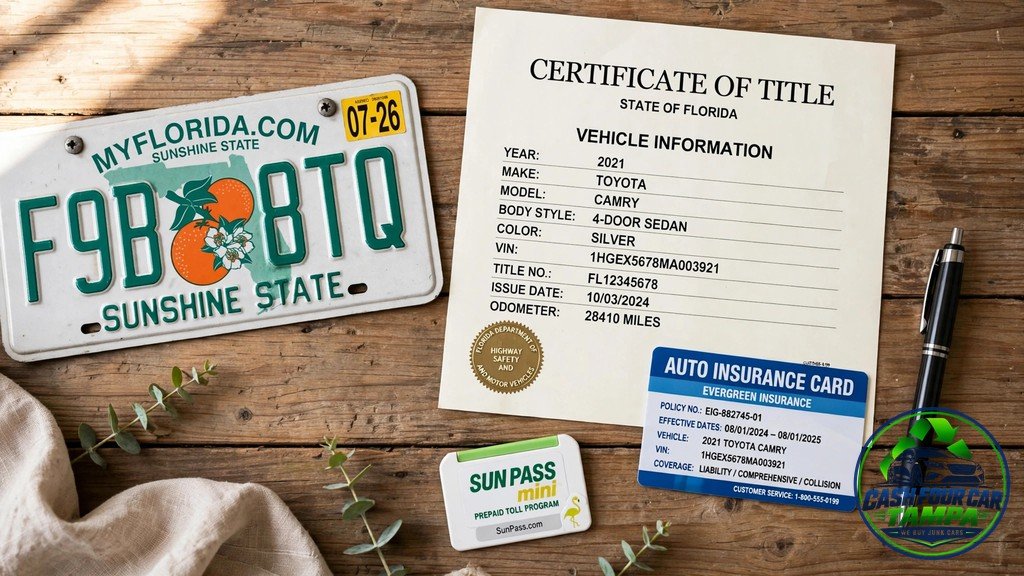
In Florida the plate belongs to you, not the car — transfer it or surrender it at the tax collector’s office. If you cancel the insurance first while the plate is still active, the state can suspend your license and charge a reinstatement fee starting at $150. A car after removal in Tampa is still tied to your plate until you surrender or transfer it, so the plate is the first item on the list, not the last. A car after removal in Tampa keeps its plate with the seller, not the buyer — the plate never goes with the car.
File Form HSMV 82050 Within 30 Days and Keep a Copy
File a Notice of Sale on Form HSMV 82050 within 30 days, as Florida Statute §319.22 requires. The form tells the state you no longer own the car, and it protects you if a toll or ticket is issued against the old plate after the sale. FLHSMV is the official source for the form, and the documents guide walks through the title, the ID, and the form you need at the curb. Keep a copy of the filed form with your receipt — a car after removal in Tampa can still generate paperwork with your name on it until that notice is on file.
Cancel Insurance, Remove Your SunPass Tag, and Keep Your Receipt and Signed-Title Copy
Once the plate is surrendered or transferred, cancel the insurance — you are paying for a car you no longer own. Pull the SunPass tag off the windshield and close the account, or the next driver through a toll could charge it. Keep the receipt, a copy of the signed-over title, and your copy of the Notice of Sale in one folder. A car after removal in Tampa leaves your driveway in an afternoon, but the paper trail is what proves the sale happened, so keep it a year.
Title and Ownership After Removal: Derelict, Salvage and Certificate of Destruction
A car after removal in Tampa ends up in one of three buckets: derelict, salvage rebuildable, or certificate of destruction — and only one of them can ever return to the road.

Derelict: Under $1,000, 10+ Years Old, Never Titled Again
A derelict motor vehicle is at least 10 model years old, valued under $1,000, and sold to a licensed salvage dealer or a registered secondary metals recycler. The seller and the dealer complete a derelict certificate application, and the department cancels the title record. The derelict certificate is the paper that proves a car after removal in Tampa will be dismantled. A car after removal in Tampa that goes the derelict route will be dismantled or converted to scrap metal — it is never titled again.
Salvage-Rebuildable vs Certificate of Destruction: 80% and 90% Thresholds
An uninsured car is a total loss when repairs would cost 80 percent or more of replacing it with a car of like kind and quality. For a late model vehicle — 7 model years or newer — worth at least $7,500, repair costs at 90 percent or more of retail value mean the department prints a certificate of destruction. Florida Statute §319.30 sets out both thresholds. A car after removal in Tampa with a salvage rebuildable title can be repaired, inspected, and re-titled; a car with a certificate of destruction cannot — the department will never title it again.
When a Car Can Never Be Titled Again — and When It Can Return to the Road
A car can never be titled again after a certificate of destruction, after a derelict sale, or under a title marked not repairable, junked, or for parts only. A car can return to the road with a salvage rebuildable title once it is repaired, passes inspection, and is re-titled as rebuilt. If you are unsure which bucket your car falls into, ask which route applies before you book — the guide on how to sell a junk car without a title walks through both routes.
Environmental and Safety Handling: What Must Be Handled Specially in Florida
A car after removal in Tampa is drained, stripped of hazards, and stored on sealed ground before anything is crushed — that is the law, not a courtesy.
Fluids, Refrigerant, Battery and Airbags: Drain, Recover, Never Vent or Crush
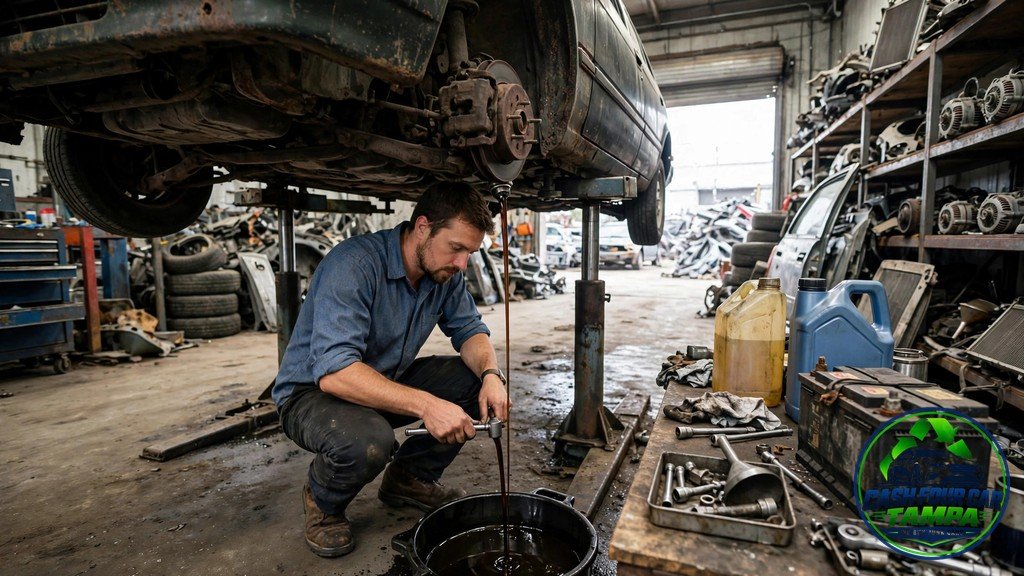
Every fluid comes out of a car after removal in Tampa first: gasoline, oil, coolant, brake fluid, and transmission fluid are drained into sealed containers. Refrigerant must be recovered with proper equipment — never vented into the air. The battery comes out for lead recycling, and airbags are removed or deployed safely — an airbag crushed in a shredder can explode. A car after removal in Tampa that skips this step is a yard cutting corners, and a yard that cuts corners here cuts them everywhere.
Tires, Catalytic Converter and Mercury Switches: Removal, Refining and the 10-Business-Day Converter Hold
Tires come off before shredding and go to their own recycling stream — rubber granules, playground surfaces, or asphalt. The catalytic converter comes off for refining, because it holds platinum, palladium, and rhodium. Florida law puts a hold on detached converters: under the Catalytic Converter Antitheft Act, a registered secondary metals recycler that buys one may not process it or remove it from the yard for 10 business days, with a few narrow exceptions, so a stolen converter can be traced. Florida Statute §538.26 sets out the hold. Mercury switches in older cars are removed and handled as hazardous waste. A car after removal in Tampa is worth more in pieces than whole partly because of these small, valuable parts — and the hold is why a converter should never be sold loose on the street.
Yard Controls: Bermed Impervious Areas, Segregated Storage, Stormwater
A compliant yard dismantles cars on bermed, impervious ground — concrete with raised edges — so oil and fuel cannot soak into the soil or run off in the rain. Fluids, batteries, tires, and parts are stored in separate, marked areas, and stormwater is managed so it does not carry oil and metals off the site. A car after removal in Tampa is dismantled on ground built for the job, and if you ever visit a yard and see cars being drained on bare dirt, that is a yard to walk away from.
Reused vs Recycled vs Landfilled: What Each Part Becomes
A car after removal in Tampa becomes reused parts, recycled metal, and a small leftover that goes to a landfill — and the split is the honest answer to what happens next.

Reused: Engines, Transmissions, Panels, Lights, Wheels and Other Parts
A car after removal in Tampa gives up anything still good, and those parts are pulled off and sold again. A running engine, a working transmission, a straight door, a clear headlight, and good wheels are all worth more as parts than as scrap, so the yard tests them and shelves them. A car after removal in Tampa with a good engine can keep three other cars on the road.
Recycled: Steel, Aluminium, Copper, Battery Lead and Converter Metals
Steel goes back to the mill, aluminum is separated by eddy currents, copper comes out of the wiring, and lead comes out of the battery. A car after removal in Tampa is roughly three-quarters metal by weight, and that metal from a car after removal in Tampa is melted down and used again in new cars, buildings, and appliances.
Landfilled: Automotive Shredder Residue — and Why No Honest Blog Can Claim 100% Recycling
After the shredder and the sorters have taken the metal, what is left is automotive shredder residue: plastics, glass, rubber, foam, and fabric. That residue goes to a landfill — the reason no honest blog can claim 100% recycling. A car after removal in Tampa is mostly recycled, and the metal almost all comes back — but the foam in the seats and the plastic in the dashboard do not, and any seller who tells you otherwise is selling you a line.
Red Flags and Scams After Removal
A car after removal in Tampa can still cause you trouble if the paperwork was done wrong — here is what to watch for.
Title Jumping and the Car That Reappears on the Road
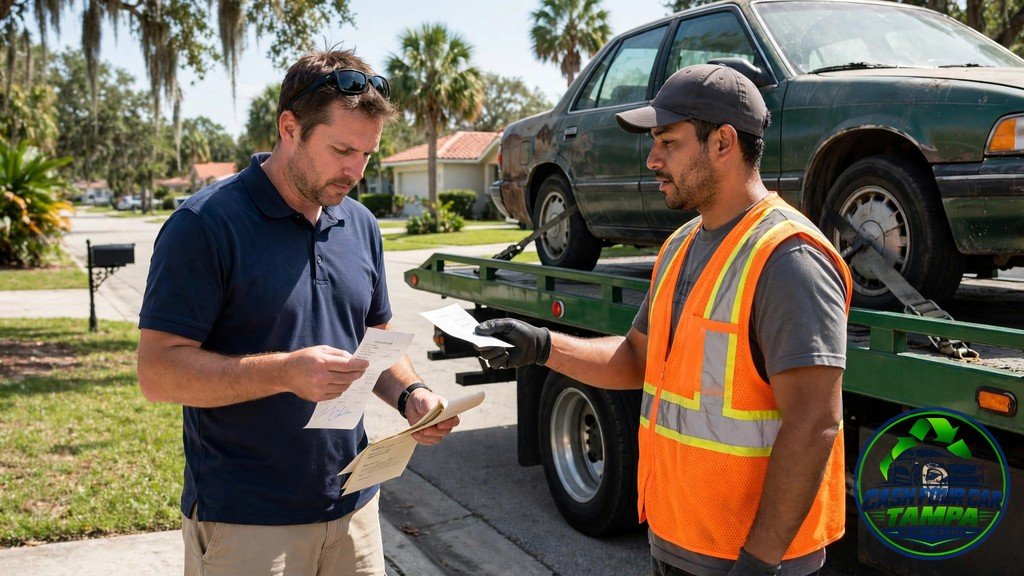
Title jumping is when a buyer takes your signed title, never records the transfer, and sells the car on to someone else. If that car is then driven or ticketed, the paper trail still points at you. The protection for a car after removal in Tampa is simple: sign the title over to the named buyer, fill in the buyer’s name and the odometer reading, and file the Notice of Sale. A car after removal in Tampa that was sold properly cannot reappear as your problem — the filed notice is what breaks the chain.
Tolls and Tickets After Pickup — and the Paperwork That Stops Them
Tolls and tickets after pickup almost always trace back to a plate or a notice that was never filed. If a toll or a ticket names your plate after the sale, the filed Notice of Sale and your receipt clear you. Once the notice is filed, a toll charged to a car after removal in Tampa is the buyer’s problem, not yours. A car after removal in Tampa should stop costing you money the day it leaves — if a bill arrives later, answer it with the paperwork.
No Receipt, Undisclosed Broker Pass-Through, and Blank-Title Pressure
No receipt means no proof of the sale or the price. Watch for a broker pass-through: the person at your curb is a middleman who sells the car on to a second buyer who may pay less than the first quote. Never sign a blank title — a title with your signature and no buyer name is an open door to title jumping. The 10 questions to ask a junk car buyer cover the receipt, the buyer name, and cash before loading.
Tampa and Hillsborough County Specifics
A car after removal in Tampa is filed, surrendered, and picked up through Hillsborough County offices and Tampa yards — here is what is local and what is not.

Filing With the Hillsborough County Tax Collector, FLHSMV’s Local Office
In Florida, the county tax collector is FLHSMV’s local office. In Hillsborough County that means the downtown Tampa office at 601 E Kennedy Blvd, with branches on Falkenburg Road, Hillsborough Avenue, and Westshore Boulevard. A car after removal in Tampa is filed through that office, and the staff there can confirm whether a car after removal in Tampa still shows a lien on its record. Check the Tax Collector’s website for hours and appointments before you drive over.
Tampa Yards, Parts Yards and Shredding Capacity: What Is and Is Not Confirmed
What is confirmed: Tampa has licensed salvage yards and parts yards, and the same Florida rules apply to every one of them. What is not confirmed: this guide does not list individual yard names or shredding capacity, because no public list verifies them and the live site publishes none. A car after removal in Tampa goes to a licensed yard — but which yard is a question for the buyer on the call, not a claim in this guide.
What Cash Four Car Tampa Does — and Does Not — State About After-Removal Handling
The business states what happens at pickup — free towing, same-day pickup, cash on the spot — and it does not publish what happens to a car after it leaves your driveway. A car after removal in Tampa is sold to Cash Four Car Tampa on the strength of the pickup promises, and anything about the yard itself is a question to ask on the call.
Why Tampa Sellers Choose Cash Four Car Tampa
A car after removal in Tampa starts with a quote, and the quote is where the sale is won or lost.
Free Towing, Same-Day Pickup and Cash on the Spot: Homepage Claims Only
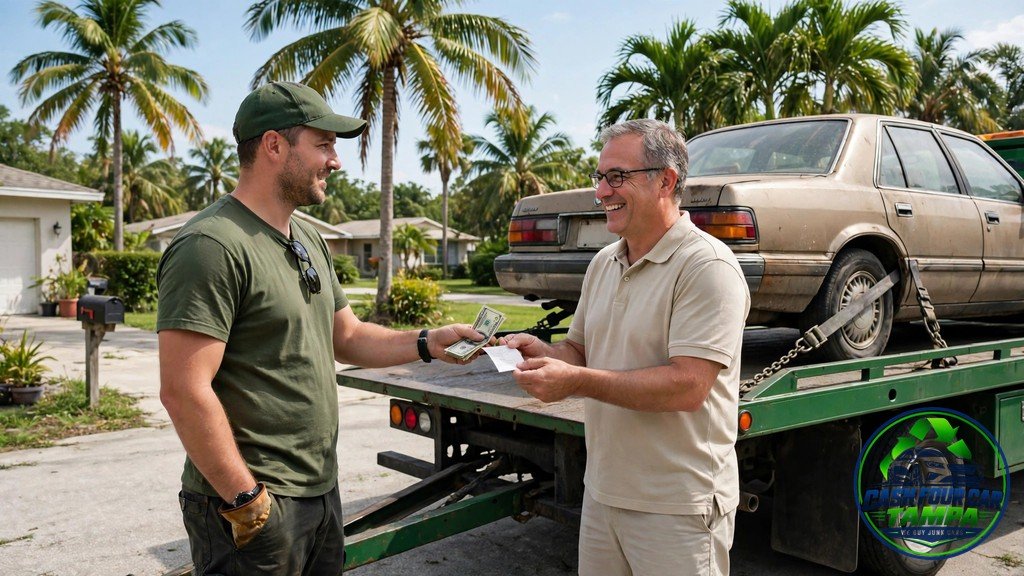
The homepage promises free towing, same-day pickup, and cash on the spot. A car after removal in Tampa is picked up free, paid for in cash at the curb, and gone the same day you call — that is what the homepage says, and that is what to hold the buyer to.
Get a Written Net Quote Before Pickup
A written net quote is one cash number that already includes free towing, with no fee added at the curb. Tell the buyer the year, make, and model, whether it runs, and what is missing. Call (813) 321-4445 any day from 7:00 AM to 9:00 PM, and the yard is at 902 N Tampa St, Tampa, FL 33602. With 4.9 out of 5 stars from more than 127 reviews and over 500 cars purchased, the record is public. The fastest way to start is to get a quote today.
FAQs: What Happens to Your Car After Removal in Tampa?
Three questions come up on almost every call about a car after removal in Tampa.
Is My Junk Car Crushed Immediately After Removal in Tampa?
A car after removal in Tampa is checked in first, and a derelict sale waits out the hold period — 3 business days with no lien, 10 days with a recent one. After that it is depolluted, stripped of parts, then crushed and shredded. A car after removal in Tampa can sit at the yard for days or weeks before the shredder, depending on the yard.
Can My Junk Car Be Driven or Re-Titled Again After Removal?
A car after removal in Tampa with a salvage rebuildable title can be repaired, inspected, and re-titled as rebuilt. A car after removal in Tampa with a certificate of destruction or a derelict certificate can never be titled again — it is parts and scrap metal from that day on.
What Should I Do With My Plate and Insurance After Removal?
Take the plate off, surrender or transfer it, file the Notice of Sale within 30 days, then cancel the insurance. Pull the SunPass tag off a car after removal in Tampa too. A car after removal in Tampa stops being your responsibility when the plate is surrendered, the notice is filed, and the insurance is cancelled — in that order.