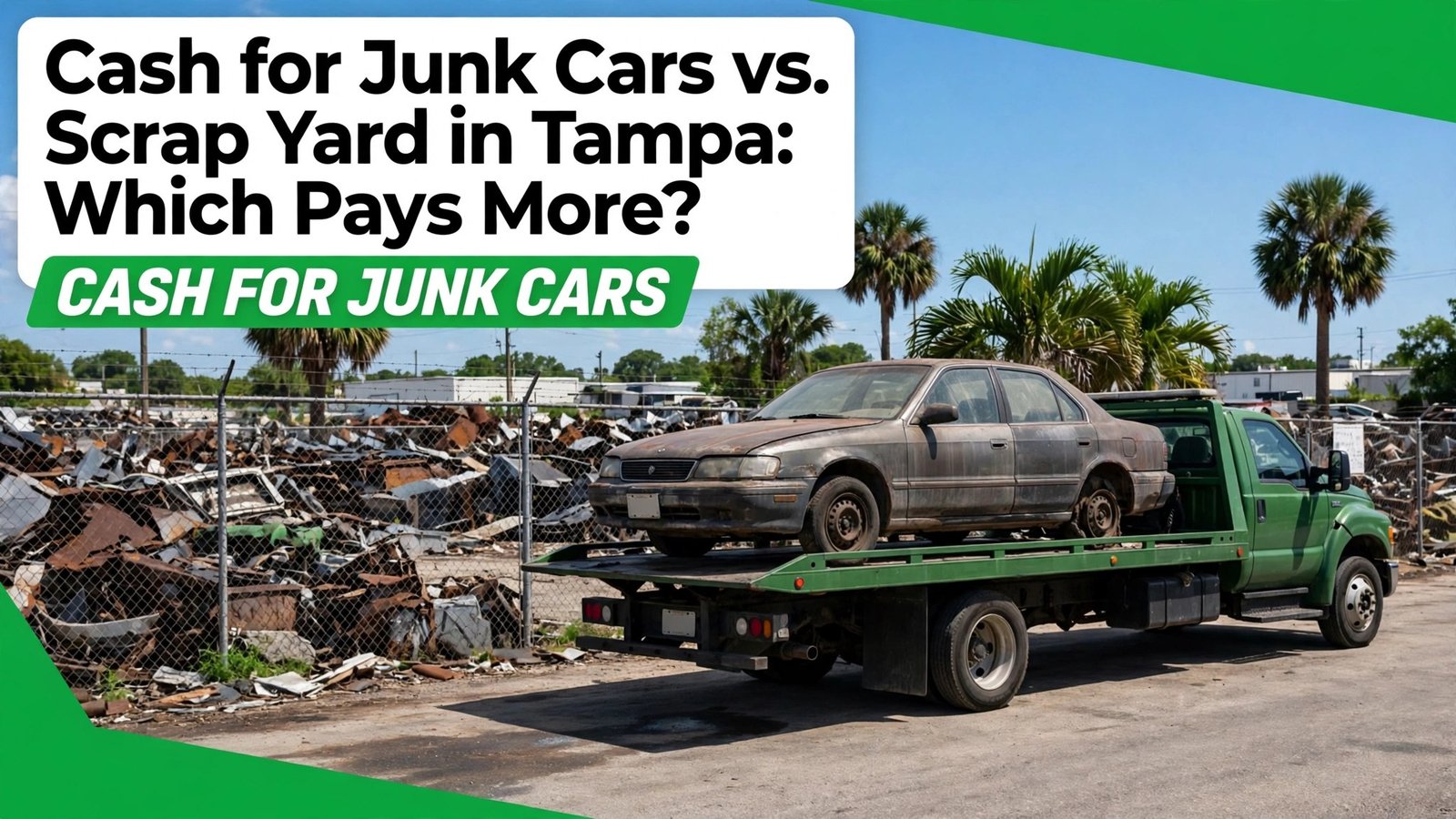
For a complete junk car in Tampa, a direct cash buyer usually pays more net than a scrap yard, because the buyer pays for the parts on top of the scrap floor while the scrap yard pays mostly for weight. A scrap yard can win for a stripped, heavy hulk you can deliver yourself. The right choice depends on what your car is, not on which name sounds better.
Cash Buyer vs Scrap Yard in Tampa: Which Pays More? The Short Answer
The short answer is that the complete car wins with the buyer and the bare shell wins with the scale. A cash buyer prices the engine, transmission, converter and wheels as well as the metal, while a scrap yard prices the metal and deducts everything else.

Typical Complete Junk Car: Direct Cash Buyer Usually Wins Net
A complete car is worth more than its weight, and a direct cash buyer is the one who pays for that extra value. The buyer adds a parts premium on top of the scrap floor, then tows the car free and pays before loading. A scrap yard, by contrast, starts from the same scrap floor and stops there, because it buys metal by weight and sells no parts.
Yard Can Win for a Stripped, Heavy Hulk You Can Deliver
A stripped hulk flips the math. Once the engine, transmission and converter are gone, there is no parts premium left for a buyer to pay. If that hulk is heavy — a full-size truck or SUV body — and you can deliver it yourself on a trailer, a scrap yard can match or beat a buyer. The yard wins only when the car is heavy, stripped and already on your trailer.
Neither Wins for a Repairable or Resale Car
If the car still runs, or needs only a modest repair to run again, neither a cash buyer nor a scrap yard is the right sale. Both price a car as scrap or parts, so both will offer far less than a private buyer. A running car with a clean title belongs on a private sale, not on a flatbed to the yard. Selling a repairable car for scrap is the one mistake that costs more than any fee or deduction in this guide.
What Each Option Is in Tampa
Three kinds of buyer answer the phone in Tampa, and they are not the same business. A direct cash buyer quotes, pays and tows with its own truck. A broker or marketplace quotes the car and passes it to someone else. A scrap yard buys metal by weight and sells no parts.
Direct Cash Buyer: Quoter, Payer, and Driver Are the Same
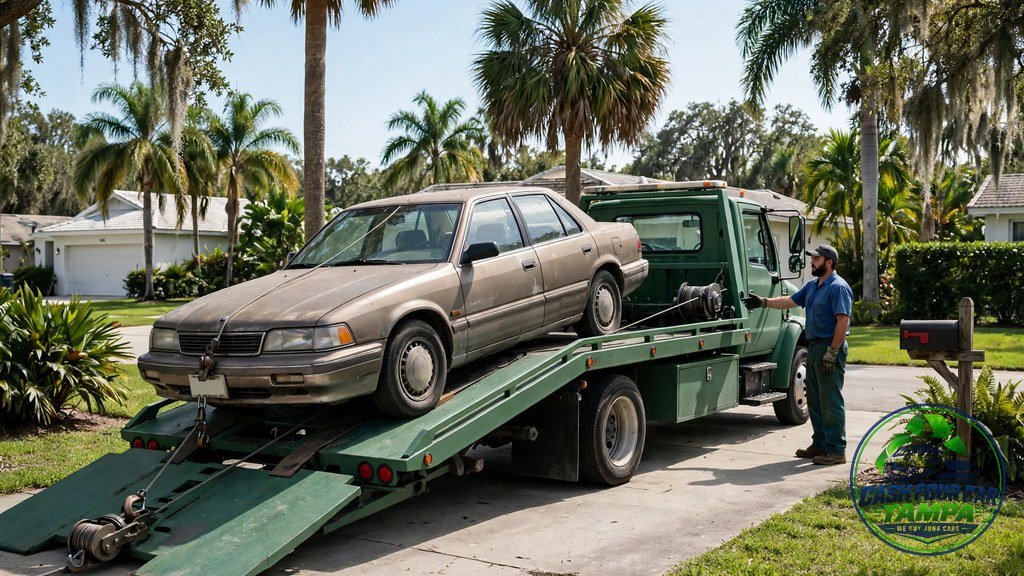
With a direct cash buyer, the person who quotes the car is the person who pays for it. Cash Four Car Tampa works this way: the quote comes from the business, and payment happens before the car is loaded. There is no second buyer to approve the price at your driveway, so the number you agreed on is the number you are paid. A scrap yard works differently — it pays for weight at its scale.
Broker and Marketplace: Quoter, Payer, and Driver Can Differ
A broker or an online marketplace quotes a number, then finds a local buyer to collect the car. The driver who arrives works for that local buyer, not for the company that quoted you. That is the pass-through risk: the quote was one business’s number and the payment is another business’s decision. Our guide to how cash for junk cars works explains the direct route in full, and it is the route this comparison measures the yard against.
Pure Scrap Yard vs Salvage and Parts Yard
A pure scrap yard buys metal by weight. It weighs the car, pays a per-ton rate, and sends the shell to a shredder. A salvage yard, also called a parts yard, buys whole cars, sells the usable parts, and sends what is left to the shredder. That is why a salvage yard can pay more than a pure scrap yard for a complete car: it has a second way to earn from the same vehicle. In Tampa the words get mixed up, so ask the scrap yard whether it sells parts before you judge its number.
This illustrated walkthrough follows a scrap car through the shredder-and-furnace route a pure scrap yard sends it down — draining, crushing, shredding, magnetic sorting and melting into new steel. It is an animated explainer, not footage of a Tampa yard.
Price Comparison: Cash Buyer vs Scrap Yard in Tampa
The price gap between the two options comes from two different formulas. The buyer starts with the scrap floor and adds a parts premium; the scrap yard starts with the scrap floor and subtracts its costs. The figures below are published ranges with dates, not offers.
Scrap Formula: Curb Weight Divided by 2,000 Times Dollars per Ton, Minus Deductions
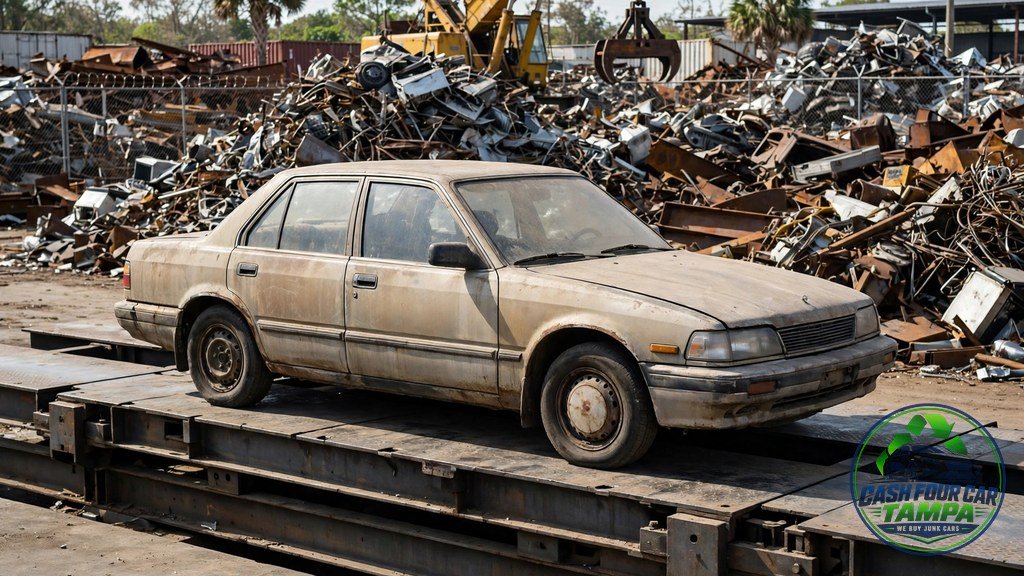
The scrap floor is simple: curb weight divided by 2,000 gives tons, and tons times the per-ton rate gives the metal value. Reap My Ride’s page, checked live on 2026-11-06, puts scrap at $195 a ton in October 2026, which makes a 3,300-pound sedan worth about $320 and a 5,000-pound pickup about $490. The iScrap App average was $177.27 a ton on September 29, 2026, which puts the same sedan near $266 and the same pickup near $443 — ceilings for the metal, not offers. A scrap yard then subtracts its deductions, while a buyer adds the premium.
Parts Premium on Top of the Scrap Floor
The parts premium is the money a buyer pays above the scrap floor. Reap My Ride’s published ranges put a working engine at $200 to $600, a working transmission at $150 to $400, and a catalytic converter at $50 to $400 or more. A missing converter takes $50 to $250 off, a missing engine or transmission takes $200 to $500 off, and missing wheels or tires take $80 to $200 off. A scrap yard pays none of that premium, because it does not sell parts.
Towing, Dockage, and Processing Deductions That Shrink the Headline
The headline is not the net figure. A scrap yard may charge for the tow, deduct a processing or dockage fee, and pay the lowest ferrous grade for a whole car. Buyers pay on the weight the car shows on the scale, not the curb weight in the manual. Ask for the per-ton rate, the tow charge and every deduction in writing before you agree to anything. Our guide to how much cash you can get for a junk car runs the same ranges in full.
Convenience and Speed: Cash Buyer vs Scrap Yard in Tampa
Price is only half the sale. The other half is who comes to you and how fast the money arrives. A direct buyer and a scrap yard run on opposite schedules here, and the gap is often bigger than the price gap.

Pickup vs Drop-Off
A direct cash buyer comes to the car. The tow is free, the truck is theirs, and the car is loaded from your driveway without you driving anywhere. A scrap yard expects the opposite: you deliver the car to its scale, on a trailer or on a tow you arrange and pay for. If the car does not run, that delivery means hiring a tow, and the bill comes out of the yard’s price.
Scheduling and Payment Timing
A direct buyer quotes in about 60 seconds, books same-day pickup in most cases, and pays before the car is loaded. Cash Four Car Tampa is open seven days a week from 7:00 AM to 9:00 PM, and the payment terms for your sale are confirmed on the call. A scrap yard runs on its own hours and its own queue: you drive in and wait for the scale. The yard’s payment timing is confirm-before-you-deliver, because no Florida rule found in this guide’s research sets how a yard must pay — Florida Statute Section 538.26 sets a 10-business-day hold on a detached converter, not a payment method.
Paperwork Handling at Pickup or Drop-Off
A direct buyer handles the paperwork at pickup: the title is signed over, the plates come off, and the Notice of Sale is filed. A scrap yard handles the paperwork at the scale: title, photo ID and the VIN, with the car weighed before anything is signed. Either way the seller’s job is the same — have the title in your name, keep the plates, and file the Notice of Sale within 30 days.
Paperwork and Title: Cash Buyer vs Scrap Yard in Tampa
The paperwork is the same, and it is the seller’s responsibility. Title, photo ID, VIN and odometer go with the car; the plates stay with you. The scrap yard and the buyer differ only in what they can accept when the title is missing.

Title Transfer, Photo ID, VIN, and Odometer
Both a buyer and a scrap yard need the same three things before they pay: the title, photo ID that matches it, and the VIN on the car. The odometer reading is recorded: under Florida Statute Section 319.225, a 2011 or newer model is exempt from odometer disclosure after 20 years, and a 2010 or older model after 10 years. A scrap yard will also check that the engine, transmission, converter, wheels and body panels are all there before it weighs the car.
Plates Stay With Owner: Surrender Before Cancelling Insurance
The plates stay with you, whichever option you choose. Remove the plates before the truck leaves, then surrender them and cancel the insurance after the sale is complete, not before. Cancelling insurance while the plate is still active can bring a suspension notice, and a plate left on a car you no longer own can bring tolls and tickets in your name. The FLHSMV site has the surrender steps, and the same order applies at a scrap yard scale as at a buyer’s pickup.
Notice of Sale Within 30 Days, Plus Derelict, Duplicate, and Salvage Pointers
File the Notice of Sale on Form HSMV 82050 within 30 days, as Florida Statute Section 319.22 requires. If the title is lost, the duplicate-title route on Form HSMV 82101 applies. If the car is 10 model years or older and worth under $1,000, the derelict route under Florida Statute Section 319.30 may apply instead, for a licensed salvage dealer or registered recycler only. A pure scrap yard may refuse a car with no title outright, while a licensed salvage dealer can take it under the derelict route when it qualifies.
Red Flags for Each Option in Tampa
The red flags are the same kind for both options, with one extra for each side. A buyer who will not put the number in writing is a risk, and a scrap yard that will not show you the scale ticket is a risk.
Headline vs Net and Pickup-Day Price Cuts
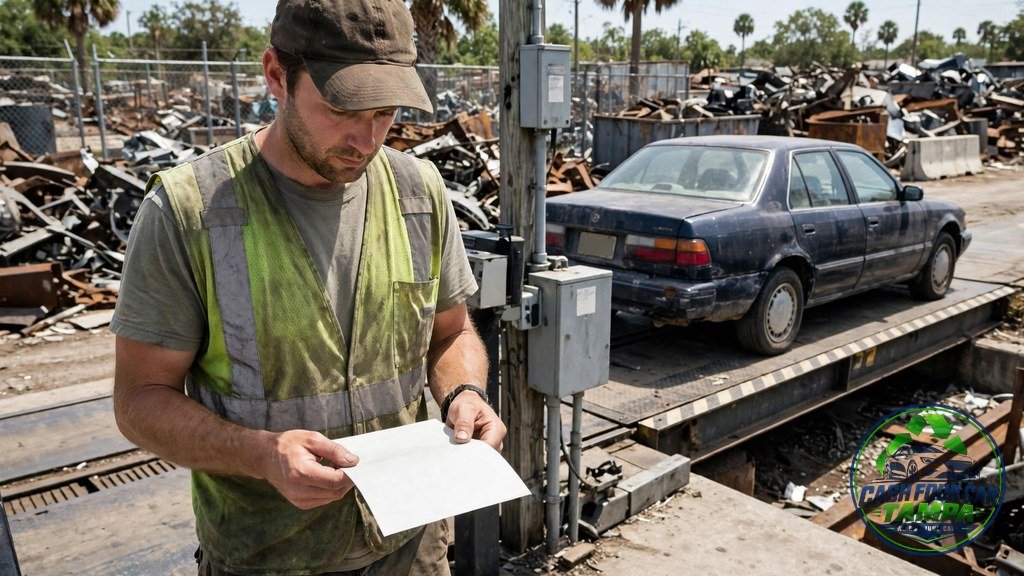
A headline is not an offer until the net figure is written down. Get the net figure in writing before you book, and the cut has nowhere to hide. At a scrap yard, the cut usually arrives at the scale: a lower grade than quoted or a heavier tare weight than expected. At a buyer’s pickup, the cut arrives when the driver re-prices the car. Our guide to how to compare cash offers explains headline versus net in full.
No Written Quote, Blank Title, and Broker Pass-Through
Three signs, one problem: a seller who will not stand behind the deal. A blank title is the worst of the three, because the car can be passed on without your name ever being on the paper. A broker pass-through means the person at your door is not the buyer. A junk car sold to a buyer or a yard that will not give those details in writing is a sale to a stranger.
Scrap Yard Weighing and Payment Tricks
The scale is where a scrap yard sale is won or lost. Ask to see the scale ticket with gross weight, tare weight and net weight, and check that the tare weight matches the truck or trailer that brought the car in. Mixed metals are paid at the rate of the cheapest metal, so separate copper, brass and aluminum before you go. And confirm the payment method before delivery, and get it in writing.
Decision Matrix and Tampa and Hillsborough Notes: When Buyer Wins, When Yard Wins
The decision comes down to three facts about your car: is it complete, is it heavy, and can you deliver it. The matrix below turns those facts into a choice.

Buyer Wins: Complete, Parts-Rich, or Hard-to-Tow Cars
The buyer wins whenever the car has value beyond its weight. A complete car with a working engine, transmission and converter earns the parts premium only a buyer pays, and a car that does not roll earns it too, because the buyer brings the flatbed and the winch. A car with missing parts still earns more from a buyer than from a scrap yard in most cases, because the parts that remain are worth more than their weight — the missing-parts guide runs that math in full.
Yard Wins: Stripped, Heavy Hulks You Can Deliver
The yard wins: a stripped, heavy hulk you can deliver yourself. The engine, transmission and converter are gone, and the body is heavy enough that the per-ton rate adds up — a full-size truck or SUV shell on your own trailer. The scrap yard also wins when you have loose metal to sell, because it pays by the pound for copper, brass and aluminum. If you cannot deliver the hulk yourself, the tow bill hands the win back to the buyer.
Tampa Buyers, Yards, and Filing Office: Hillsborough County Tax Collector
No Tampa buyer or yard publishes a price policy that this guide could quote. What is public is where the sale is filed: the Hillsborough County Tax Collector, downtown at 601 E Kennedy Blvd. Pickup covers Tampa and Hillsborough County — Downtown 33602, Ybor City 33605, Hyde Park 33629, South Tampa 33629, West Tampa 33607, Carrollwood 33618, Temple Terrace 33617, Westchase 33626, Town ‘n’ Country 33615, New Tampa 33647, Brandon 33511, Riverview 33578, and Plant City 33563. A scrap yard sale is filed the same way as a buyer sale: the route changes, the filing does not.
| Your car | Who pays more | Why |
|---|---|---|
| Complete car, engine and converter present | Direct cash buyer | Parts premium plus free towing |
| Stripped, heavy hulk you can deliver | Scrap yard | Per-ton rate, no premium to lose, no tow bill |
| Car that does not roll, steer or brake | Direct cash buyer | Buyer brings flatbed and winch |
| Repairable or resale car | Neither — sell privately | Both price it as scrap, far below resale |
| Car with no title | Ask first — yard may refuse | Duplicate or derelict route; yard may refuse |
Get Cash for Your Junk Car From Cash Four Car Tampa
Cash Four Car Tampa buys junk cars, with free towing and same-day pickup. Whether your car belongs with a buyer or at a scrap yard, the call tells you in a minute.

What to Tell the Business First: Car Facts, Title, and Location
Have five things ready when you call: the year, make and model; whether the engine, transmission, converter and wheels are present; the title — clean, salvage, or missing — and whether a lien is on it; and where the car sits, with truck access. A car described honestly on the call is priced once. If the car is a stripped hulk you can deliver, say so.
What Happens Next: Offer, Pickup, and Payment Terms in Writing
Payment terms are not promised on the homepage, so ask for the offer, the pickup time, and the payment terms in writing. To start, get a quote online or call (813) 321-4445 from 7:00 AM to 9:00 PM. With 4.9 out of 5 stars from more than 127 reviews and over 500 cars purchased, the record is public. A junk car sold to a direct buyer is still a same-day pickup in most cases.
FAQs About Cash for Junk Cars vs Scrap Yard in Tampa
The same three questions come up on almost every buyer-versus-yard sale in Tampa — who pays more, whether the yard wins on a heavy car, and whether a title is needed. The short answers are below.
Does a Cash Buyer Pay More Than a Scrap Yard in Tampa?
In most cases, yes. A direct cash buyer pays the scrap floor plus a parts premium for the engine, transmission, converter and wheels, while a scrap yard pays the scrap floor alone. On a complete car the buyer usually wins, and the buyer also tows free. The yard wins only on a stripped, heavy hulk you can deliver yourself, where there is no premium left to pay.
Can a Scrap Yard Pay More for a Heavy Junk Car in Tampa?
It can, when the car is stripped and heavy and you deliver it yourself. A full-size truck or SUV shell with no engine, transmission or converter is worth its weight and nothing more, so a scrap yard paying the per-ton rate can match or beat a buyer. The win disappears if you have to hire a tow to the yard. Heavy alone is not enough.
Do I Need a Title to Sell to a Scrap Yard in Tampa?
Yes, in most cases. Most yards ask for the title, photo ID and the VIN before they weigh the car. If the title is lost, the duplicate-title route on Form HSMV 82101 applies, and if the car is 10 model years or older and worth under $1,000, the derelict route under Florida Statute Section 319.30 may apply. Ask the yard which route it accepts before you load the car.