Yes — a flood-damaged car still brings cash in Tampa, because buyers pay for scrap metal and whatever parts the water did not ruin. A flood-damaged car is priced on what survives: the steel, the parts that stayed dry, and the title brand. This guide explains what counts as flood damage, how Florida titles it, and how the offer is built.
Can You Get Cash for a Flood-Damaged Car in Tampa? The Short Answer
A flood-damaged car is worth its metal, its dry parts, and sometimes its repair value. The buyer weighs the car, checks what the water reached, and reads the title brand. The three questions are the water level, the parts that survived, and the brand.
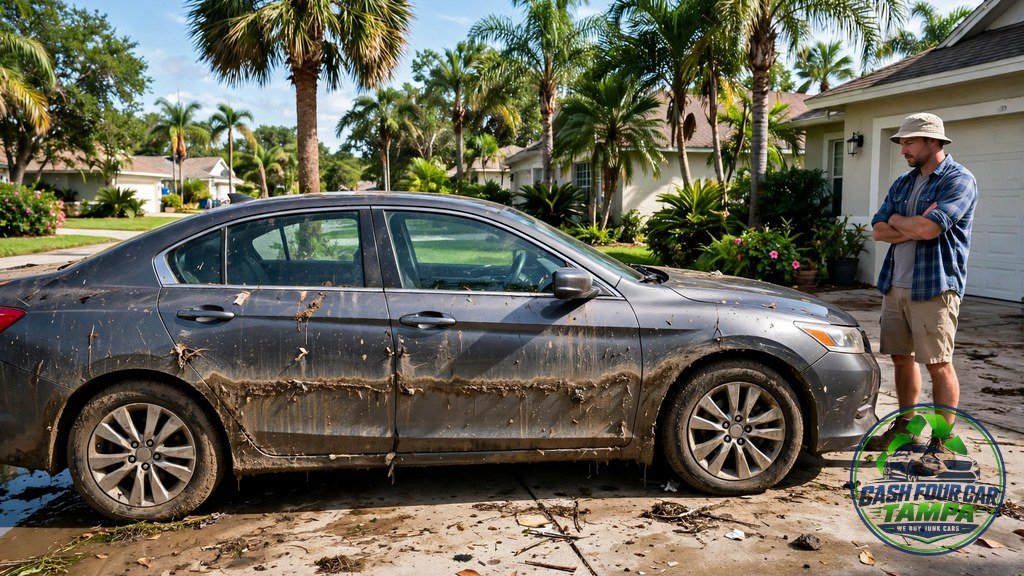
Scrap Metal and Salvageable Parts, Not a Road Car
A flood-damaged car is priced as scrap and parts, never as a road car. The scrap floor comes from weight: tons times the price of scrap steel, which moves daily. On top of that floor sits the parts premium — the engine, transmission, converter, and wheels a yard can still sell. A flood-damaged car with water only at the floor can keep most of that premium, while a car soaked to the dash keeps almost none.
Scrap-Only vs Parts-Plus-Scrap
The split is simple: a car is scrap-only when the water ruined everything that could sell, and parts-plus-scrap when something dry survived. Carpets, seats, and wiring fail first, so a car with water at seat level is usually scrap-only. A car with water below the floor can still sell its engine, transmission, and converter. The buyer decides the split for a flood-damaged car by the waterline, not by how the car looks after a wash.
What Cash at Pickup Does and Does Not Guarantee
Cash at pickup means the buyer pays the agreed net figure when the truck loads the car — nothing more, nothing less. It does not guarantee the headline number from the first call, because the quote is checked against the car at pickup. Get the net figure in writing before you book, and a flood-damaged car pays exactly what the paper says.
What Counts as Flood-Damaged in Tampa?
A flood-damaged car is any car that sat in standing water long enough for the water to reach its parts. Rain on the roof does not count. The test is the waterline: how high the water rose, and how long it stayed.
Water Level and Duration
Two facts decide the damage: how high the water rose and how long it stayed. Water below the floorpan usually costs carpets and padding. Water at seat level reaches wiring, modules, and the transmission. Water over the dash soaks the engine electronics and the airbag system. Hours matter as much as height for a flood-damaged car: a car that sat for a day absorbs far more than one pulled out in an hour.
Saltwater vs Freshwater: Tampa Surge as Worse Case
Saltwater is the worse case, and Tampa surge is saltwater. Salt speeds corrosion on every metal it touches: wiring pins turn green and brittle, connectors fail months later, and the frame rusts from the inside. Freshwater still ruins interiors and electronics, but it corrodes far more slowly. A flood-damaged car that sat in surge needs a lower offer than the same car in rainwater, because the corrosion keeps working long after the car looks dry.
Hidden Engine, Electrics, Interior, Mould, and Corrosion Damage
The worst flood damage hides. Water in the engine can bend a rod the first time it turns over. Water in the wiring corrodes pins that fail months later, taking windows, lights, and airbags with them. Seats and carpets hold water and grow mold in foam no detailer reaches, and the smell gives it away. Silt settles under the dash, in the spare tire well, and inside door cavities. A flood-damaged car can look clean on the outside while its electrical system is already failing.
The video below shows how to spot a flooded car before buying one. It is about buying, not selling, but the signs it shows — waterline, silt, rust, and smell — are the same facts a seller must report for an honest quote.
Florida Flood Title Rules for Flood-Damaged Cars
Florida law treats a flood-damaged car as a paper event as much as a physical one. The title brand decides whether the car can ever drive again, and the seller must disclose the flood in writing before the sale.
Flood Vehicle Definition and Written Disclosure Before Sale
Under Florida law, a flood vehicle is a car declared a total loss because of water damage. When an insurer reports the flood, the insurer brands the vehicle and reports it to FLHSMV, which marks the flood damage in a conspicuous place on the title. The seller must disclose the flood in writing before the sale, and any advertisement must state it. A flood-damaged car sold without that disclosure breaks the law, and the buyer can check the brand through the FLHSMV Motor Vehicle Information Check with the VIN or title number.
Salvage Rebuildable vs Certificate of Destruction
A flood total loss becomes one of two papers. A salvage rebuildable title means the car can be repaired, inspected, and returned to the road with a permanent rebuilt brand. A certificate of destruction means it can never be titled or driven again — parts and scrap only. The line is economic: under Florida Statute Section 319.30, an uninsured car is a total loss when repairs reach 80 percent of replacement cost, and a late-model car worth $7,500 or more gets a certificate of destruction at 90 percent of retail value. Our guide to getting cash for a wrecked car explains the thresholds a flood-damaged car is judged by.
Title Washing: What Not to Do
Title washing is retitling a car in another state to strip the flood or salvage brand off the title, then selling it as clean. Not every state brands flood cars, and not every state checks the brands other states recorded, so a washed title can look clean while the car is still a flood car. Never buy a title wash, and never sell one: a flood-damaged car must be sold with its brand disclosed in writing. Check the VIN through NMVTIS or the FLHSMV Motor Vehicle Information Check before money changes hands.
How Flood Damage Affects Your Cash Offer in Tampa
The offer starts from the same build as any junk car sale — scrap floor plus parts premium minus handling — and flood changes each part of the offer for a flood-damaged car. Water takes the premium first and the floor never.
| Flood effect | What survives | What is lost |
|---|---|---|
| Water below the floor | Steel body, frame, and most parts | Carpets and padding |
| Water at seat level | Scrap weight and some metal | Interior, electrics, and modules |
| Water over the dash | Scrap weight only | Engine, transmission, and electronics |
| Saltwater surge | Scrap weight only | Nearly every part and system |
Scrap Floor: Weight Times Metal, Survives Any Flood
The scrap floor is the car’s weight in tons times the price of scrap steel. At $195 a ton in October 2026, a 3,300-pound sedan’s metal is worth about $320 and a 5,000-pound pickup’s about $490 — an illustration, not a fixed price, because scrap moves daily. Water cannot take the floor away: a flood-damaged car that lost its engine still holds its steel. Weight is the one part of the offer that flood cannot touch, which is why even a soaked flood-damaged car still brings cash.
Parts Premium Lost to Flood
The parts premium is where flood does its damage. A working engine is worth about $200 to $600, a working transmission about $150 to $400, and an intact catalytic converter about $50 to $400 or more, by one buyer’s published ranges. Flood or fire damage cuts about $200 to $500 from the value. A flood-damaged car with water at seat level keeps almost no premium, because the engine, transmission, and converter all sat in water. That is the premium a flood-damaged car loses first.
Further Deductions: Missing Parts, Title Brand, and Undisclosed Damage
Missing parts subtract directly, and a missing converter is the single largest deduction on any offer. The title brand sets the ceiling: a clean title leaves every route open, a salvage brand narrows the buyer pool, and a certificate of destruction leaves only parts and scrap. Undisclosed damage on a flood-damaged car cuts hardest of all: if the buyer finds water the seller never mentioned, the quote is re-priced at the curb. Our guide to how much cash you can get for a junk car shows where the flood deduction sits in the full value picture for a flood-damaged car.
Before Pickup: Safety and What to Have Ready in Tampa
Before the truck arrives, a flood-damaged car needs safety first and papers second. Water and electricity do not mix, and floodwater carries contamination. Get the car safe, then get the papers ready.
Do Not Start, Jump, or Test; Disconnect Battery If Safe; Document Waterline
Never start, jump, or test a car that sat in floodwater. Water inside the engine can bend a rod on the first crank, and water in the wiring can short the moment power flows. If you can reach the battery safely, without standing in water, disconnect it. Photograph the waterline inside and out — on the doors, the seats, and under the hood — before anything is moved or cleaned. Those photos are the honest record a flood-damaged car needs for its quote.
Title, Photo ID, VIN, Keys, Lien, and Insurance-Settlement Status
Have six things ready before pickup day for a flood-damaged car. The title, signed in your name, with the buyer, price, and odometer reading filled in. Photo ID that matches the name on the title. The VIN, so the buyer can check it against the title and the brand. The keys, if you still have them. The lien: if a lender holds one, bring the payoff figure and the lender’s name. And the insurance: tell the buyer whether a claim is open or settled, and whether the insurer already branded the flood-damaged car as a total loss.
Empty the Car, Clear Access, and Report Rolls, Steers, and Brakes
Empty the car before pickup day: personal items, plates, and anything in the trunk. Floodwater ruins what it touches, so check the trunk and the glove box for papers worth saving. Clear a path for the truck — move other cars, open the gate, and tell the buyer about steps, slopes, or soft ground. Report honestly whether the car rolls, steers, and brakes, because a flood-damaged car that does none of the three needs dollies and a winch, not a rollback.
Quote to Cash: Towing and Step by Step in Tampa
From quote to cash, a flood-damaged car follows the same steps as any junk car sale. The difference is the quote: it needs the flood facts, not just the year and model.
Honest Quote: Height, Duration, Salt or Fresh, Starts, Rolls, Steers, Brakes, Missing Parts, and Brand
Give the buyer the full flood picture before the quote: how high the water rose, how long it stayed, salt or fresh, whether the car starts, rolls, steers, and brakes, what is missing, and the title brand. Every fact changes the number, and a fact left out is a price cut at the curb. A flood-damaged car quoted on honest facts keeps its number; one quoted on guesses does not. That is how a flood-damaged car gets a quote that holds.
Loading: Flatbed and Winch for Non-Runners, Dollies Only With Neutral and Correct Axle
A flood-damaged car that will not run loads on a flatbed, pulled up by winch. If the wheels are locked, the driver sets a dolly under each locked wheel — but only with the transmission in neutral and the dolly on the correct axle, or the drivetrain takes damage. A flood-damaged car with a bent frame or a crushed corner may need a forklift. Our guide to how to get cash for a non-running car covers the loading equipment in full; this section covers the flood.
Pickup Day: Verify VIN, Title, and ID; Pay Before Loading; Sign and Keep Copies
On pickup day, check three things before the car moves: the VIN on the car against the title, the title against your photo ID, and the buyer name against the one you booked. Ask to be paid before loading, and count the cash before the car leaves the ground. Sign the title only when the money is in hand, file the Notice of Sale within 30 days, and keep copies of everything. A flood-damaged car sells on the same papers as any car — the flood changes the price, not the paperwork.
Paperwork Pointers, Red Flags, and Tampa and Hillsborough Notes
A flood-damaged car brings the same paperwork and the same red flags as any junk car sale, plus a few flood-only notes. Tampa adds its own: zones, two hurricanes, and one filing office.
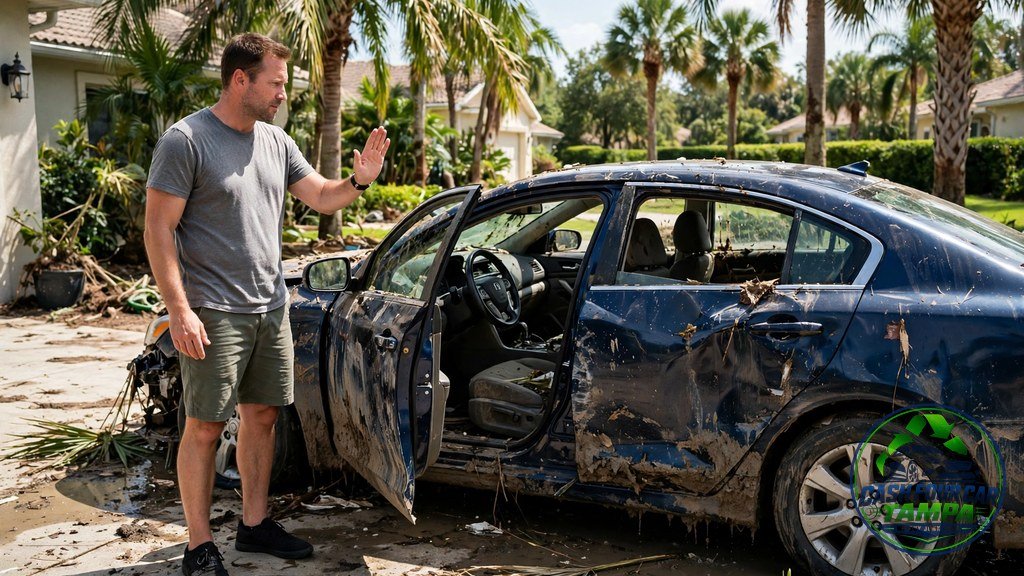
Title Transfer, Photo ID, VIN, Odometer, Plates, and Notice of Sale Within 30 Days, Plus Derelict and Duplicate Pointers
At pickup, fill in the buyer, price, and odometer reading on the title, and bring photo ID that matches the name on it. Remove the plates before the truck leaves, and file the Notice of Sale on Form HSMV 82050 within 30 days, as Florida Statute Section 319.22 requires, so later tickets and tolls do not come back to you. If the title is lost, the duplicate-title route on Form HSMV 82101 applies; if the car is 10 model years or older and under $1,000, the derelict route may apply instead. Our guide to how to sell a junk car without a title covers both routes.
Headline vs Net, Pickup-Day Cuts, No Written Quote, Blank Title, Broker Pass-Through, and Title Washing
The red flags are the same on a flood sale. A headline that is not a net figure, a price cut at the curb for water you already described, no written quote at all, a blank title, a broker who takes a cut and passes the car on, and a washed title presented as clean — any one of them ends the sale. A flood-damaged car with a washed title is the worst of the six, because the buyer is hiding the flood itself.
Tampa Flood Zones vs Evacuation Zones, Helene and Milton, and Hillsborough Filing Office
Flood zones and evacuation zones are two different systems. FEMA flood zones — AE, VE, X — map flood risk for insurance and building rules. Hillsborough evacuation zones — A to E — map storm surge and tell you when to leave; Zone A leaves first. A home can sit in a low flood zone and still be ordered out, or the other way round. Helene hit Tampa Bay on September 26, 2024, with a surge of more than 6 feet, and Milton followed on October 9; the two storms left Tampa full of flood-damaged cars. File the title at the Hillsborough County Tax Collector, downtown at 601 E Kennedy Blvd, Tampa.
Get Cash for Your Flood-Damaged Car From Cash Four Car Tampa
Cash Four Car Tampa buys flood-damaged cars across Tampa and Hillsborough County, with free towing and same-day pickup. Tell us about the flood, the title brand, and the location first.
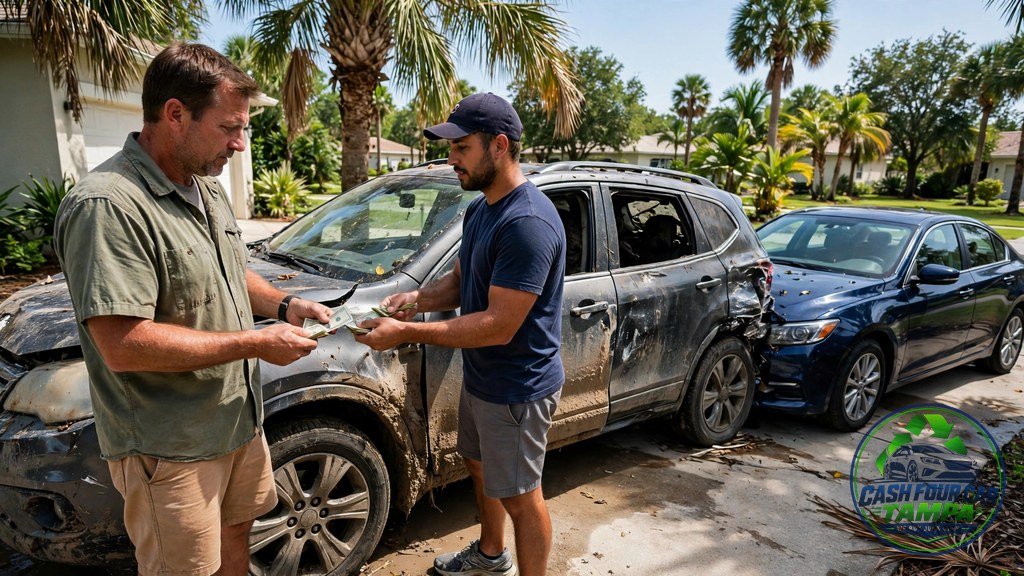
What to Tell the Business First: Flood Facts, Title Brand, and Location
Have five things ready when you call: how high the water rose and how long it stayed, salt or fresh, whether the car starts, rolls, steers, and brakes, the title brand — clean, salvage rebuildable, certificate of destruction, or missing — and where the car sits, with truck access. Say whether the insurer already branded the car, and name every missing part, because those facts decide the quote a flood-damaged car comes back with. The quote takes less than 60 seconds, and the pickup is free with same-day service in most cases.
What Happens Next: Offer, Pickup, and Payment Terms in Writing
Payment terms and pickup handling are not promised on the homepage, so ask on the call for the offer on your flood-damaged car, the pickup time, and the payment terms in writing before you agree to anything. To start, get a quote online or call (813) 321-4445 any day from 7:00 AM to 9:00 PM. With 4.9 out of 5 stars from more than 127 reviews and over 500 cars purchased, the record is public.
FAQs About Getting Cash for a Flood-Damaged Car in Tampa, Florida
The same three questions about flood damage come up on almost every sale in Tampa.
Can I Sell a Flood-Damaged Car That Won’t Run in Tampa?
Yes. A flood-damaged car that will not run still sells for scrap and whatever parts stayed dry, and the buyer brings a flatbed and a winch to load it. Tell the buyer it does not run before the quote, because a non-runner is priced and collected differently from a roller.
Does Saltwater Damage Lower My Tampa Flood Car Offer More Than Freshwater?
Yes, it does. Saltwater corrodes wiring, connectors, and the frame far faster than freshwater, and the damage keeps growing months after the car looks dry. A flood-damaged car that sat in surge is priced lower than the same car in rainwater, because almost nothing electrical can be trusted to last.
Can a Certificate of Destruction Flood Car Ever Be Driven Again in Tampa?
No. A certificate of destruction means the car can never be titled or driven again, in Florida or anywhere else. It sells only to a licensed salvage dealer or recycler, for parts or scrap. A flood car with a salvage rebuildable title is different: it can be repaired, inspected, and returned to the road with a permanent rebuilt brand.